
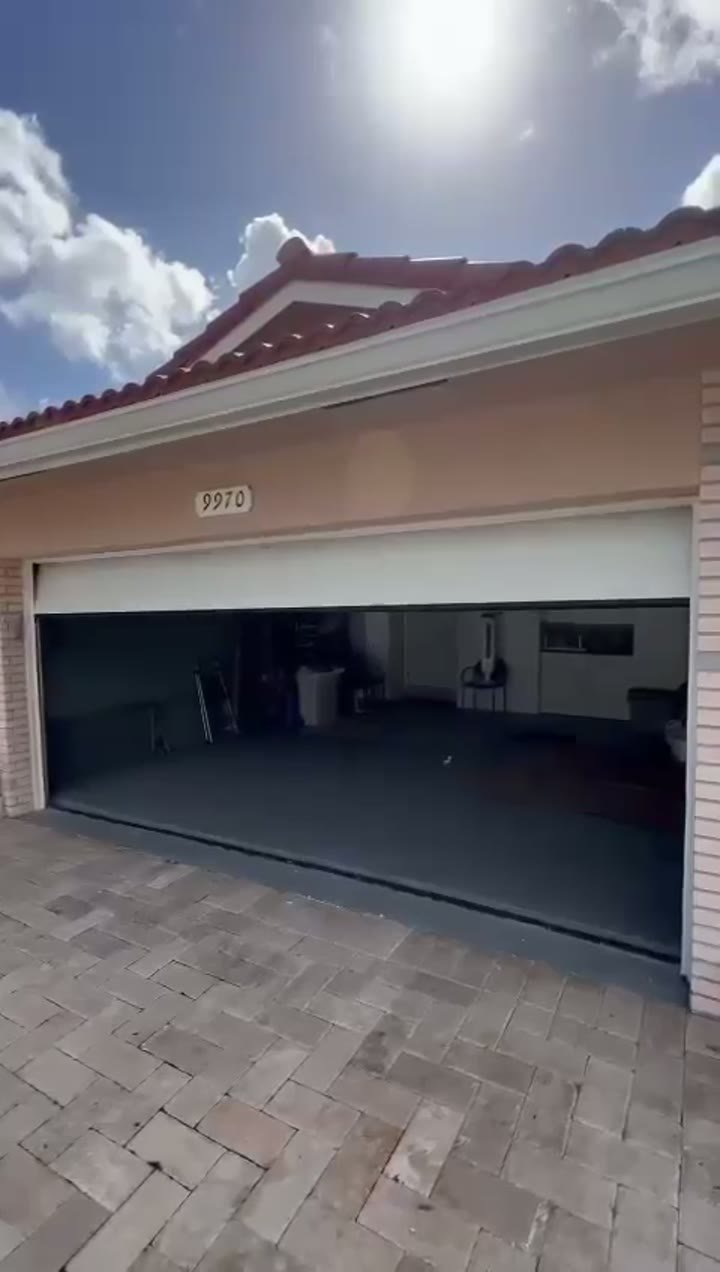
When a hurricane hits a South Florida home, the garage door is statistically the most likely large opening to fail. When it does, interior wind pressure builds and lifts the roof from the inside — the same failure pattern documented in Andrew (1992), Wilma (2005), and Irma (2017). The Insurance Institute for Business and Home Safety (IBHS) ranks garage door failure among the top three causes of catastrophic structural loss in Florida hurricanes. See how we install HVHZ-rated doors in Sunrise →.
Homeowners spend money protecting windows. Roofers install hurricane straps. But the largest opening on most South Florida homes — the garage door — often gets the lightest treatment. That is backwards. Here is why.
The Balloon Effect (Pressurization Failure)
The danger from a failed garage door is not the wind itself. It is what happens to the rest of the house once the door is gone.
A house in a hurricane is, fluid-dynamically, a closed pressure vessel. When the wind gusts, air flows around the structure, creating zones of positive pressure on the windward side and negative pressure (suction) on the leeward side and the roof. As long as the building envelope is intact, the inside stays close to atmospheric pressure, and the loads on individual surfaces stay within design tolerances.
When the garage door fails — punctured by debris, blown in by direct pressure, or pulled out by suction — wind enters the garage. The garage volume pressurizes almost instantly. That pressure then acts outward on every other surface of the home: the ceiling between the garage and living space, the wall connecting to the rest of the house, and most catastrophically, the roof.
Imagine inflating a balloon from the inside. The skin of the balloon does not tear at the inflation point. It tears at the weakest seam. In a house, that seam is the roof-to-wall connection.
What IBHS Found in Their Wind Tunnel Tests
The Insurance Institute for Business and Home Safety operates a full-scale wind testing facility in Richburg, South Carolina. They have tested intact homes versus identical homes with a single garage door failure, at the same wind speeds. The results are consistent across multiple test series:
- An intact home at 120 mph sustained wind shows manageable interior pressure load on all surfaces
- A home with a failed garage door at the same wind speed shows roof uplift loads 250–400% higher on the windward eave
- In some test runs, the entire roof structure separated within 90 seconds of garage door failure
IBHS ranks garage door reinforcement second only to roof-deck attachment in cost-effectiveness for residential hurricane retrofits.
The Andrew, Wilma, Irma Pattern
Three South Florida hurricanes provide the field evidence:
Hurricane Andrew (August 1992). Post-storm damage surveys in Homestead and southern Miami-Dade documented thousands of single-family homes where the entire roof structure was missing. Engineering forensic reports tracing the failure sequence repeatedly identified the garage door as the initial breach point. Andrew is the primary reason the Florida Building Code now exists in its current form and why HVHZ standards apply across Miami-Dade and Broward.
Hurricane Wilma (October 2005). Broward and Palm Beach County took the brunt. Even with FBC HVHZ rules already in force, homes built before 1994 — without HVHZ-compliant garage doors — showed disproportionate roof loss. Homes built or upgraded under the post-Andrew code performed dramatically better.
Hurricane Irma (September 2017). Irma weakened before landfall in South Florida, sparing Broward from the worst-case scenario — but Naples and the Florida Keys took higher winds. Damage surveys again traced catastrophic roof loss to garage door failures, primarily on homes with non-compliant or aged doors.
Why Newer Homes Are Not Automatically Safe
Most Sunrise homes built after 2002 were constructed under the current Florida Building Code and have an HVHZ-rated original garage door. But two factors degrade that protection over time:
- Door age. HVHZ doors are rated as a complete system — panels, springs, tracks, fasteners. After 15–20 years of Florida sun, salt, and humidity, the springs and fasteners weaken even if the panels look fine.
- Modifications. Any service work that changes the original installation — replacement panels not from the original manufacturer, springs swapped without matching torque ratings, brackets repositioned — can invalidate the NOA approval. The door is technically no longer the certified product.
The safest assumption for a Sunrise home with an original 2002–2008 HVHZ door: it probably needs a wind mitigation re-inspection before the 2026 season. We do those for free.
What You Can Do in 18 Days (Before June 1)
Hurricane season starts June 1. For Sunrise homeowners reading this in mid-May, three actions are achievable in the time remaining:
- Look at the inside of your top garage door panel right now. Is there a label or sticker with a Miami-Dade NOA number? If yes, take a photo and save it. If no, you likely do not have an HVHZ-rated door.
- Schedule a free inspection. If the door is unrated or older than 15 years, an HVHZ-compliant replacement can be permitted and installed in 7–14 days during May. Wait until late August and you are competing with everyone else who waited.
- If replacement is not in budget this year — install a bracing kit. A $200–$500 horizontal bracing kit on an existing door is not as good as full replacement, but it is dramatically better than nothing.
Free Pre-Season Hurricane Inspection
We will check your garage door for NOA documentation, verify the bracing, inspect springs and fasteners, and tell you exactly where it stands — no charge, no pressure.