
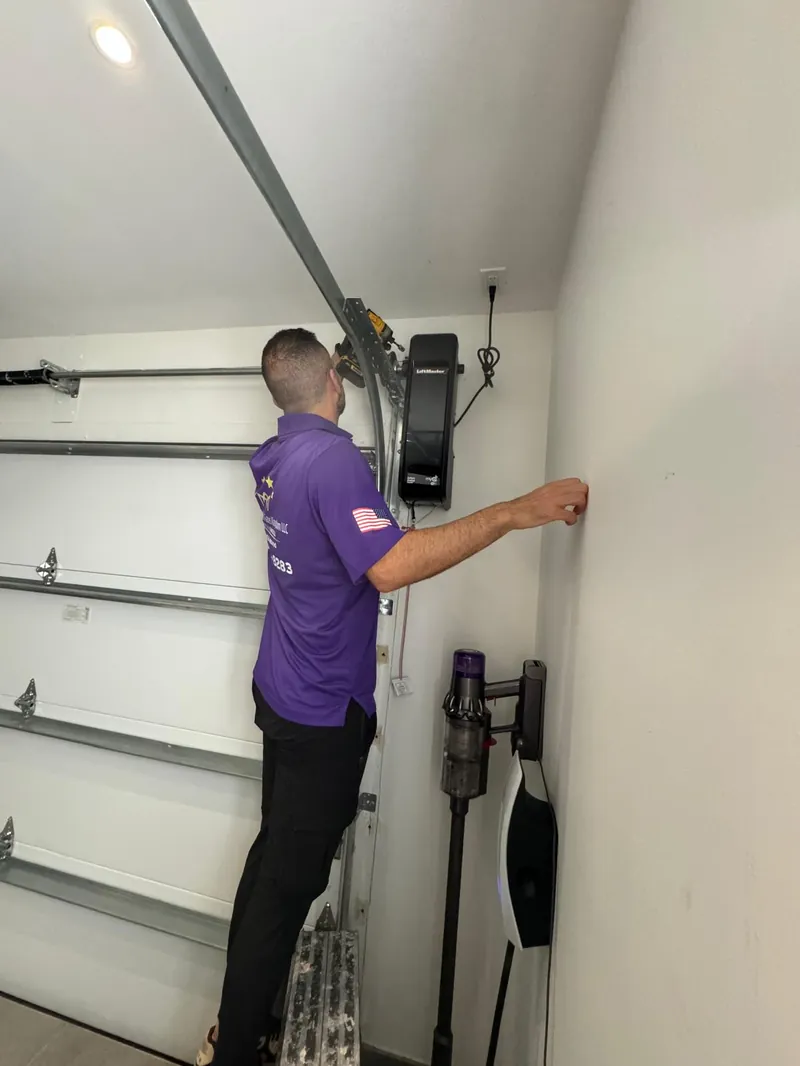
Florida SB-969 requires battery backup on residential garage door openers sold or installed in Florida after July 1, 2026. It was passed in 2023 after Hurricane Ian killed residents who could not evacuate when power loss disabled their electric openers. The law is forward-looking only — your existing opener is not retroactively illegal. Compliant models include LiftMaster 8500W, LiftMaster 84505R, Chamberlain B6753T, and equivalents. Garage Door Kingdom installs only SB-969-compliant openers as of July 2026. Call (786) 258-8283 for an opener review.
Florida SB-969 is one of the most important pieces of post-hurricane life-safety legislation passed in the last decade for South Florida homeowners, and almost nobody outside the garage door industry knows it exists. This guide is for Broward County homeowners who want to know what the law actually says, what it requires of installers like us, and what it means for their next garage door opener purchase.
What Florida SB-969 Actually Requires
Stripped of legalese, Florida SB-969 says one thing: every residential automatic garage door opener sold or installed in the State of Florida after July 1, 2026 must include an integrated battery backup capable of operating the door during a utility power failure.
That is the entire functional core of the law. The statute also includes definitions (what qualifies as "residential," what counts as "automatic"), exemption language (commercial overhead doors are excluded; manual doors with no electric opener are excluded), and the enforcement framework (civil penalties for non-compliant sales or installations).
For a homeowner, the practical takeaway is simple: after July 1, 2026, any new opener you install in Broward County (or anywhere in Florida) must have battery backup. There is no minimum-power-loss exception, no rural exception, no "the buyer waived it" exception.
Why Florida Passed This Law
SB-969 was passed in direct response to Hurricane Ian, which made landfall in southwest Florida in September 2022 as a Category 4 storm. Ian was the deadliest hurricane to hit Florida since 1935, killing 156 people directly.
Several of those deaths were tied to a specific failure pattern: residents who had hurricane-rated garage doors (often the only egress path from a flooded street-side door) found themselves trapped inside their homes when the storm took down power. Modern hurricane-rated doors are heavy — 200 to 400 pounds depending on size — and physically difficult or impossible for an elderly or injured person to lift manually after disconnecting the opener.
The legislative analysis behind SB-969 specifically cited these post-Ian fatalities as the motivating fact pattern. The bill itself was modeled on a California law (also numbered SB-969, signed in 2018) passed after the 2017 California wildfires created the same evacuation-failure pattern: people unable to leave because power loss disabled their garage door openers, in homes where the only practical egress route was through the garage.
Florida looked at California's legislation, looked at the Ian fatality pattern, and adopted nearly the same statutory language with a 2026 effective date to let the residential opener market transition.
Which Openers Comply (And Which Do Not)
The compliance test is straightforward: does the opener have integrated battery backup? Not optional, not an add-on accessory, but built into the unit so that during a power loss the unit can open and close the door for some specified number of cycles.
Current compliant models we install in Broward County include:
- LiftMaster 8500W and 8500C — wall-mount jackshaft openers with built-in battery backup. Ideal for hurricane-rated doors because they free up overhead space and have very strong torque.
- LiftMaster 84505R — belt-drive ceiling opener with integrated battery backup and MyQ smart-home support.
- LiftMaster 87504-267 — newer belt-drive model with battery backup and updated motor.
- Chamberlain B6753T — belt-drive opener with integrated battery backup and smart-app support.
- Chamberlain B6765 — premium belt-drive with battery backup.
- Genie StealthDrive Connect 7155 — DC belt opener with optional battery backup module that is treated as integrated when bundled at sale.
Non-compliant openers — the ones that will become illegal to sell or install in Florida after July 1, 2026 — include any chain-drive AC opener without battery backup, the older LiftMaster Premium Series (1/2 HP and 3/4 HP without BBU), and the legacy Genie ScrewDrive line. These are still installed in many Broward homes from the 2000s and early 2010s. You can keep them; you just cannot replace them with another like-for-like non-backup unit after the effective date.
What If My Existing Opener Does Not Comply?
Two scenarios. First, your existing opener works fine: do nothing. The law does not retroactively require replacement of working openers. Keep using it until it dies, then replace with a compliant model.
Second, your existing opener is at end of life or you are doing a hurricane-prep upgrade: just choose a compliant model. The price premium for battery-backup-equipped openers is real but not enormous — typically $50 to $150 over a comparable non-BBU model — and the value during a power outage is obvious.
If you live in a Broward County HOA community, factor in the HOA architectural review process. We cover that on our HOA Compliance Hub. The opener itself is rarely visible from the street and almost never triggers an ARC review, but the new door (if you are replacing the door at the same time) usually does.
Penalties for Installers
For homeowners reading this, the penalty section matters because it is the reason your licensed contractor cannot install a non-compliant opener even if you ask them to.
The statute authorizes civil penalties against any retailer or installer who sells or installs a non-compliant residential automatic garage door opener after the effective date. The penalty schedule is tiered: a small first-offense fine, larger fines for repeat violations, and the possibility of DBPR (Florida Department of Business and Professional Regulation) license review for licensed contractors with multiple violations.
For Garage Door Kingdom, this means: after July 1, 2026, we cannot install a non-compliant opener even if the homeowner brings us their own unit and asks us to install it. We are happy to discuss compliant alternatives and explain the trade-offs, but we cannot put our Broward CC# 21-GD-22352-X license at risk by installing non-compliant equipment.
Florida SB-969 vs Florida Building Code 1620.2
These are sometimes confused. They are different laws covering different things.
- Florida Building Code 1620.2 sets wind-load requirements for openings (including garage doors) in the High-Velocity Hurricane Zone (HVHZ). It is about the door — whether the door panels can survive design-pressure wind loads without failing inward.
- Florida SB-969 sets battery-backup requirements for residential garage door openers. It is about the motor — whether the opener can move the door during a power outage.
Both apply in Broward County. A 2026 install in Sunrise, Pembroke Pines, Coral Springs, or anywhere in Broward needs an HVHZ-listed wind-rated door and an SB-969-compliant battery-backup opener. We cover the door side on our Hurricane Preparation page. If your door itself is nearing end-of-life, pairing the SB-969-compliant opener with a new garage door installation saves a second service call and a second permit fee.
What This Means for Broward Homeowners
If you are budgeting for a new garage door system in 2026 or later, build the SB-969 compliance cost into the estimate — it is now a permanent part of the install. If you are replacing only the opener (door is fine), do not buy a clearance non-BBU unit from a big-box store and ask your installer to put it in. After July 1, 2026, they cannot legally do it.
If you have an elderly parent or relative in a Broward home with a hurricane-rated door and no battery backup on the opener, this is a meaningful safety upgrade independent of the law. Heavy hurricane doors are not easy to lift manually, and a $400–$700 opener upgrade can be the difference between safe evacuation and being trapped.
How Battery Backup Actually Works in a Florida Power Outage
One of the most common questions we get when explaining SB-969 is mechanical: "how does battery backup actually keep my garage door working when the lights are out?" The answer is mostly engineering and a little common sense.
A modern battery-backup garage door opener has a sealed lead-acid or lithium-ion battery built into the motor housing or wall-mount unit. The battery is trickle-charged from utility power during normal operation, so it stays at full charge essentially indefinitely. When utility power drops, the opener automatically switches to battery power within milliseconds. Most compliant units provide enough stored energy for 20–50 full open-and-close cycles before the battery needs to be recharged from utility power again.
The "20–50 cycles" range covers the realistic post-hurricane scenario in South Florida: in the days after Ian and Irma, many Broward homes were without power for 3–10 days. A homeowner who needs to come and go from the garage two or three times a day during recovery work is well inside the cycle budget of a properly charged battery-backup unit. The battery is not designed to operate forever; it is designed to bridge the multi-day power outage window so residents can evacuate, re-enter, and access supplies stored in the garage.
Battery health is the one ongoing thing homeowners should know about: sealed lead-acid batteries typically last 3–5 years in Florida humidity, lithium-ion 5–10. Compliant openers warn you (light blink pattern, app notification) when the battery is at end of life. Replacement is a $50–$150 part on most units and can be DIY or done by us during a routine service visit.
What to Ask Your Installer Before July 2026
If you are getting opener quotes in 2026, ask these specific questions:
- "Is this opener SB-969 compliant after July 1, 2026?" — should be a confident yes with the specific model named.
- "What is the battery technology and how many cycles does it provide on a full charge?" — a real installer can answer this without checking notes.
- "What is the expected battery lifespan in Florida humidity, and what does a replacement cost?" — budget planning for years 3–5.
- "Will this opener work with my existing remotes and keypads, or do I need new ones?" — most modern openers are universal, but verify.
- "Are you pulling a Broward County permit for this install?" — some opener-only swaps do not require permits; some do. Get the answer.
If the installer is vague on any of those, get a second quote.
Official Resources
- Florida Senate — search SB-969 for the full bill text and legislative history.
- Florida Building Commission — for related Florida Building Code requirements.
- Florida Department of Business and Professional Regulation (DBPR) — for contractor licensing and enforcement.
Need a Florida-Compliant Garage Door Opener in Broward County?
Garage Door Kingdom installs only SB-969-compliant battery-backup openers across Sunrise, Pembroke Pines, Coral Springs, Fort Lauderdale, and all of Broward County. Free quote, same-day install in most cases, bilingual EN/ES.
Florida SB-969 FAQs
When does Florida SB-969 take effect?
SB-969 was signed in 2023 with a phased rollout. The full residential requirement — battery backup on all new residential garage door openers sold or installed in Florida — takes effect July 1, 2026. After that date, an installer or retailer who sells or installs a non-compliant opener faces civil penalties.
Does SB-969 apply to my existing opener?
No. The law applies to openers sold or installed after the effective date. Existing openers without battery backup are not retroactively illegal, and you are not required to replace one that is working. The law applies the next time you replace or install a new opener.
Which openers comply with SB-969?
Any opener with integrated battery backup. The most common compliant models in Broward County right now are LiftMaster 8500W and 8500C wall-mount jackshaft openers (built-in battery), LiftMaster 84505R and 87504-267 belt-drive models with battery backup, and Chamberlain B6753T and similar models. Genie also offers backup-equipped models. The key spec to look for is "integrated battery backup" or "BBU" in the model description.
Why did Florida pass SB-969?
Hurricane Ian (September 2022) killed 156 people directly. Several deaths were tied to residents being unable to evacuate because power loss disabled their electric garage door openers and they could not manually lift heavy hurricane-rated doors. The law was modeled on California's 2019 battery-backup law (SB 969 in California, same number, passed after California wildfires created similar evacuation problems).
What are the penalties for installing a non-compliant opener after July 2026?
The statute authorizes civil penalties against the installer or retailer. Penalties scale with whether the violation is a first offense or repeated. For a licensed contractor, repeated violations can also trigger Department of Business and Professional Regulation (DBPR) license review. We comply on every install — partly because it is the right call for our customers in a hurricane zone, and partly because our Broward CC# 21-GD-22352-X license depends on it.