
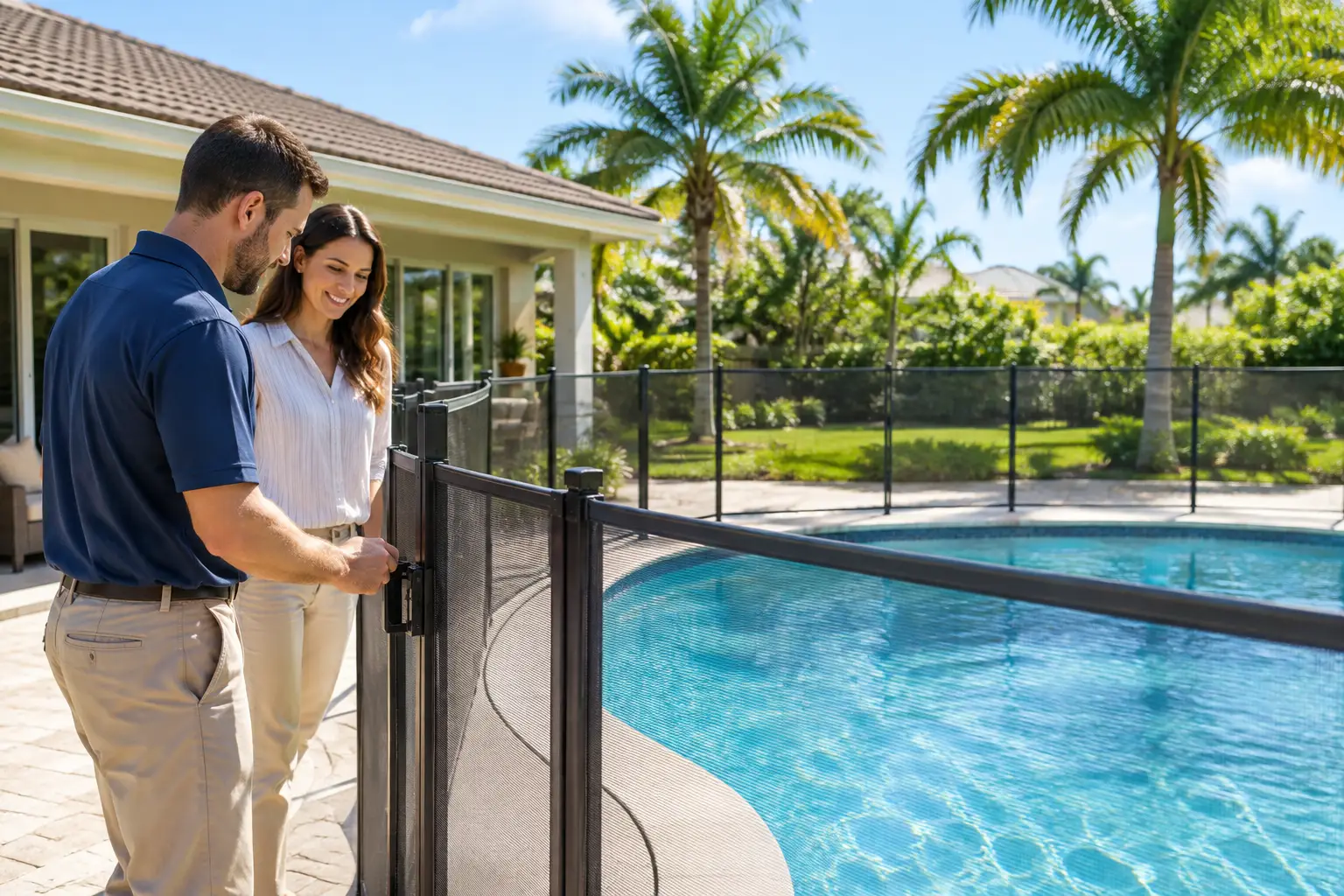
Call (786) 258-8283 for a free estimate before you repair, replace, or add a pool barrier. Florida pool fence compliance is not just about putting up a four-foot fence. A gate that will not latch, a wide gap at the bottom of a panel, or a fence layout that leaves direct access to the water can create a serious safety problem and an expensive correction later.
For homeowners in Sunrise and across Broward County, pool barrier work also has to hold up against heat, rain, salt air, and hurricane-season wind. The right answer is a safe barrier that fits your property, meets applicable requirements, and still gives your family practical access to the yard.
What Florida Pool Fence Compliance Means
Florida's residential pool safety rules are designed to prevent unsupervised access to a pool, especially by young children. The barrier can be a dedicated fence around the pool or, in some situations, part of the property perimeter. What matters is whether the finished barrier creates a reliable obstacle between a child and the water.
A compliant installation is more than a product choice. Height, ground clearance, spacing between pickets or panels, gate swing direction, latch location, and nearby climbable objects all matter. A beautiful aluminum fence can still fail inspection if the gate does not self-close or the grade leaves a large opening underneath.
The general Florida standard for a pool barrier is at least 48 inches high. Openings must be small enough to prevent a young child from passing through, and the space below the barrier must also be controlled. Pool gates must generally open away from the pool and be self-closing and self-latching. The latch needs to be positioned or protected so a child cannot easily operate it.
Those are practical baseline concepts, not a substitute for a site-specific code review. Municipal requirements, permit conditions, existing conditions, and the scope of your project can affect what is required at your address.
When a Fence Project Can Trigger Pool Compliance Questions
A new pool installation is the obvious time to address safety barriers, but it is not the only time homeowners run into compliance issues. Replacing a deteriorated wood fence, rebuilding a gate after storm damage, changing a yard layout, or installing a new access gate can expose a barrier that no longer performs as intended.
This is especially common when an older fence was built along uneven ground. Years of settling, washout, landscaping changes, or a damaged bottom rail can create openings where there were none before. A gate may also sag until the latch barely catches, which defeats the purpose of a self-latching system.
Existing pools and older barriers may have different considerations than new construction. Do not assume an older setup is automatically exempt, and do not assume every repair requires rebuilding the entire enclosure. The right approach depends on the condition of the barrier, the local jurisdiction, and whether the work is considered a repair, replacement, or alteration.
Before work begins, confirm whether a permit is required and whether your city has additional requirements. That step protects you from installing a fence that has to be modified after inspection.
The Details That Cause Most Pool Fence Problems
Most compliance failures are not dramatic. They are small details that seem harmless until someone tests the barrier as a child would.
Gates are the weak point
A pool gate must close and latch on its own every time. A gate that needs a push to finish closing is not dependable. Hinges can wear, posts can shift, and heavy gates can pull out of alignment after repeated use or high winds.
The gate should swing away from the pool area when required, and the latch must be out of easy reach or otherwise protected in accordance with code. Keyed locks and access-control devices can add security, but they do not replace the need for a properly functioning self-closing, self-latching gate.
If your pool gate is dragging, slamming, sticking, or failing to latch consistently, treat it as a safety repair. Do not wait for a full fence replacement to correct it.
Gaps, grade changes, and climbable surfaces
A fence can meet the required height at one end and fail at the other because of a slope. The clearance at the bottom, the spacing between vertical members, and any openings around posts or corners need attention across the entire run.
Climbability matters too. Outdoor furniture, planters, storage boxes, low walls, equipment pads, and decorative structures near the fence can give a child a way over the barrier. A fence is only as effective as the clear space around it.
Screen enclosures are not always enough
Many South Florida homes have screened pool enclosures, but a screen structure should not be assumed to satisfy every barrier requirement by itself. Condition matters. Torn screening, damaged doors, failed closers, loose hardware, and accessible handles can create vulnerabilities.
A screen enclosure may be part of a larger safety plan, but it should be assessed for how people actually enter the pool area. If the exterior door from the home opens directly to the pool deck, additional safety measures may be necessary depending on the property and applicable requirements.
Choosing a Fence Material for a Broward County Pool Area
Aluminum fencing is a common choice around pools because it provides visibility, resists rot, and can be configured with narrow picket spacing. It also avoids the solid visual wall of privacy fencing, which many homeowners prefer when they want to keep sightlines to the water and patio.
Vinyl can work well for privacy, but its design must still control openings and gate operation. Wood offers a traditional appearance, yet Florida humidity, insects, and water exposure demand ongoing maintenance. Chain link can be functional in the right application, although it must be evaluated carefully for climbability and required safety features.
Material is only one decision. Posts, footings, hinges, latches, fasteners, and gate frames are what keep the barrier working after years of weather. In coastal and inland Broward County, corrosion-resistant hardware is not an upgrade to overlook. A cheap latch that corrodes or a loose post after a storm can turn a compliant installation into a safety concern.
Permits, Inspections, and Hurricane Considerations
Fence permits vary by municipality and by the type, height, location, and scope of work. Pool-related barrier work can involve a closer review because it affects life safety. HOA approval may also be needed, but HOA approval does not replace municipal permitting or code compliance.
Broward County is in Florida's High-Velocity Hurricane Zone, so outdoor structures deserve careful planning. While a pool fence is not a garage door, it is still exposed to wind pressure, flying debris, saturated soil, and repeated storm stress. Proper anchoring and sound post installation help protect the fence, nearby property, and the pool enclosure itself.
Keep documentation for your project, including permit records when applicable, product information, and final inspection paperwork. It can be useful during a future sale, insurance discussion, or repair decision.
A Smart Way to Plan Your Pool Barrier Project
Start by walking the perimeter from a child's point of view. Check every gate, the bottom clearance along each fence section, loose panels, damaged latches, and objects that could be used to climb over. Then consider access patterns: who uses the yard, where service crews enter, and whether a side gate or driveway gate can lead to the pool area.
For a complete property-access project, the best result may involve more than fencing. A properly designed pedestrian gate, dependable closer, secure latch, and controlled access point can protect the pool area without making daily use frustrating. That balance is particularly valuable for families, rental properties, and HOA communities.
Garage Door Kingdom can assess pool-area fencing, gates, and access needs with the same protection-first approach used for exterior entry systems. Call (786) 258-8283 to request a free estimate before a loose pool gate or aging fence becomes a larger safety and compliance problem.