
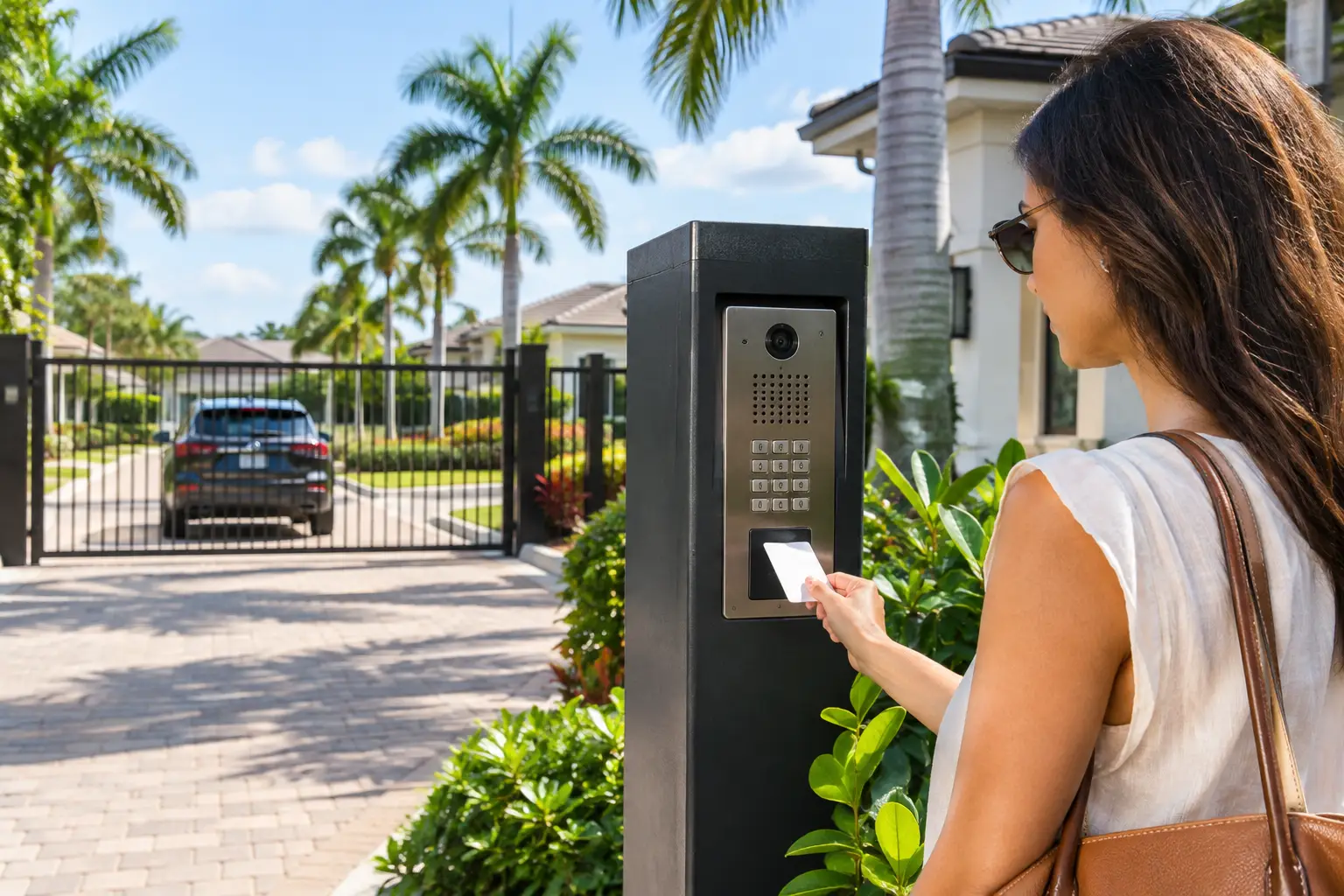
A resident stuck outside a community gate at 6:30 a.m. is not just a convenience issue. It is a security, traffic, and board-liability issue that can turn into a flood of calls within minutes. For HOA access control repairs, upgrades, or a free estimate in Broward County, call (786) 258-8283.
HOA Access Control Is More Than a Gate Opener
A controlled entrance has to do several jobs at once. It must let authorized residents in without creating a line of cars, give visitors a clear way to request entry, keep former residents and unauthorized vehicles out, and operate safely around cars, pedestrians, delivery drivers, and emergency responders.
That is why an HOA cannot evaluate an access-control system by the keypad or gate arm alone. The gate operator, vehicle loops, safety devices, credentials, entry panel, wiring, power supply, communication method, and gate hardware all work together. A failure in any one of those components can leave a community unsecured or block access altogether.
For Broward County communities, the environment adds another layer. Heat, humidity, heavy rain, salt air in coastal areas, lightning, and hurricane conditions all put pressure on electronics, metal components, hinges, tracks, rollers, and underground wiring. A system that works well on installation day still needs the right equipment, protection, and maintenance plan to stay dependable.
Start With How Residents and Visitors Actually Enter
The right system depends on the property, not a sales brochure. A 40-home gated neighborhood has different traffic patterns from a condominium with shared parking, a townhome community with multiple entrances, or an office-style HOA with service vehicles coming and going throughout the day.
Residents generally need fast, repeatable entry. Remote controls, windshield tags, RFID credentials, mobile credentials, or keypad codes can all work, but each has trade-offs. Remotes are familiar and quick, yet they are easy to lose or retain after a move. RFID tags are convenient for frequent drivers and can be deactivated individually. Mobile credentials reduce physical-device management, but the system must have dependable connectivity and a process for residents who do not use smartphones.
Visitor entry needs a separate plan. Telephone entry systems, video intercoms, directory panels, and mobile visitor passes can all be appropriate. The key question is whether residents can verify and admit a guest quickly without giving out a permanent gate code that spreads beyond the community.
For many associations, a layered setup is the practical answer: resident credentials for daily use, a video or telephone entry system for guests, and managed temporary access for contractors, delivery personnel, and vendors. The board should also determine who can add, remove, and audit credentials. If that responsibility is unclear, old codes and inactive remotes tend to remain in circulation far too long.
Choose Access Methods Based on Risk, Not Trend
A smartphone-based system may be a strong fit for a newer community with active property management. It may be less practical for a community where residents prefer remotes, do not have consistent app access, or need an entry solution that works during internet interruptions.
Likewise, a simple keypad may appear affordable upfront, but a shared code creates weak accountability. When a resident moves, a tenant changes, or a vendor relationship ends, the board may have to change the code for everyone. That creates inconvenience and still does not reveal who used the code.
Consider these four common access approaches when planning an upgrade:
- Remote controls and RFID tags: Fast for residents and easy to understand. Individual devices should be recorded and removed promptly when ownership or tenancy changes.
- Keypads: Useful as a backup method, but shared codes should not be the only resident-access plan for a security-focused community.
- Telephone entry and video intercoms: Better for visitor verification. Video adds context when a resident needs to confirm who is at the gate.
- Mobile credentials and temporary passes: Helpful for communities that want flexible visitor management, but they depend on a well-supported platform and clear administrator controls.
The best choice is not always the newest technology. It is the system your community can manage consistently, repair locally, and use without slowing down daily entry.
Do Not Ignore the Gate Itself
An access-control upgrade cannot compensate for a worn-out gate or unsafe operator. If a sliding gate binds on its track, a swing gate sags, rollers are failing, hinges are corroded, or the operator is undersized for the gate and traffic volume, residents will continue experiencing trouble no matter how advanced the entry panel is.
This is where one-team service matters. A contractor should inspect the mechanical gate, operator, safety sensors, photo eyes, loops, control board, cabling, and access device as one connected system. Replacing only the visibly failed part can lead to another service call if the underlying issue is a damaged loop, failing power supply, worn gate hardware, or water intrusion at a connection point.
Safety devices deserve special attention. A powered vehicular gate needs properly operating entrapment protection and controls appropriate to its application. Photo eyes, monitored safety edges, vehicle detection, emergency release procedures, and warning devices are not optional details to push off until later. They protect residents, guests, pets, and the association itself.
Plan for Storms, Power Loss, and South Florida Wear
An HOA entrance is often most important when conditions are worst. Before hurricane season, boards should inspect gates and operators for loose hardware, corrosion, damaged conduit, exposed wiring, water intrusion, and unreliable battery backup. If a community has a storm procedure for securing gates or managing manual access, the property manager, board members, and security staff should understand it before a storm is approaching.
Broward County is within the High-Velocity Hurricane Zone. When a project involves new gates, structural changes, fencing, or related construction, the association may need permits and documentation based on the scope and local requirements. A qualified contractor can identify what applies before work begins rather than leaving the board to discover a compliance issue after installation.
Power interruptions also need a practical answer. Battery backup can keep certain systems functioning for a limited period, but capacity depends on the equipment, gate weight, cycle frequency, and condition of the batteries. Some communities need a manual-release plan or an emergency-access procedure in addition to backup power. There is no one-size-fits-all answer, especially at high-traffic entrances.
Build a Credential Policy Before You Install Anything
Access control is partly a management process. A strong system can still become a weak point if credentials are issued informally and never recovered.
Your association should establish who approves new credentials, what documentation is required from owners and tenants, how lost devices are handled, and when access is removed. Vendors should receive limited access whenever possible rather than a permanent community-wide code. It also helps to review active credentials on a set schedule, particularly after turnover in rentals or management staff.
Keep an emergency contact and service plan as well. When a gate will not open, a vehicle is trapped inside, or the entrance has been damaged, the board should know who has authority to call for repair. Waiting for multiple approvals while the community gate is stuck open creates an avoidable security gap.
When Repair Makes Sense and When Replacement Is Smarter
Repair is often the right call when a system has a defined fault: a damaged photo eye, failed receiver, worn roller, broken hinge, bad loop detector, failing keypad, or aging battery. A properly diagnosed repair can restore reliable operation without forcing a full replacement.
Replacement becomes more sensible when the operator is repeatedly failing, replacement parts are difficult to obtain, the gate is poorly matched to the operator, wiring has widespread water damage, or the entry system cannot support the association's current credential and visitor-management needs. Repeated patchwork can cost more than a planned upgrade, especially when residents are regularly inconvenienced and security is compromised.
Garage Door Kingdom can inspect the full entry system, explain the repair-versus-replacement options clearly, and provide a free estimate before work begins. For HOA boards and property managers, the goal is not flashy technology. It is controlled entry that remains safe, serviceable, and dependable in real Broward County conditions.
A community gate should not become the reason residents are late, visitors are confused, or security is left open. Call (786) 258-8283 to schedule an HOA access control evaluation and get a free estimate from a local team that can handle the gate, automation, and entry system together.