
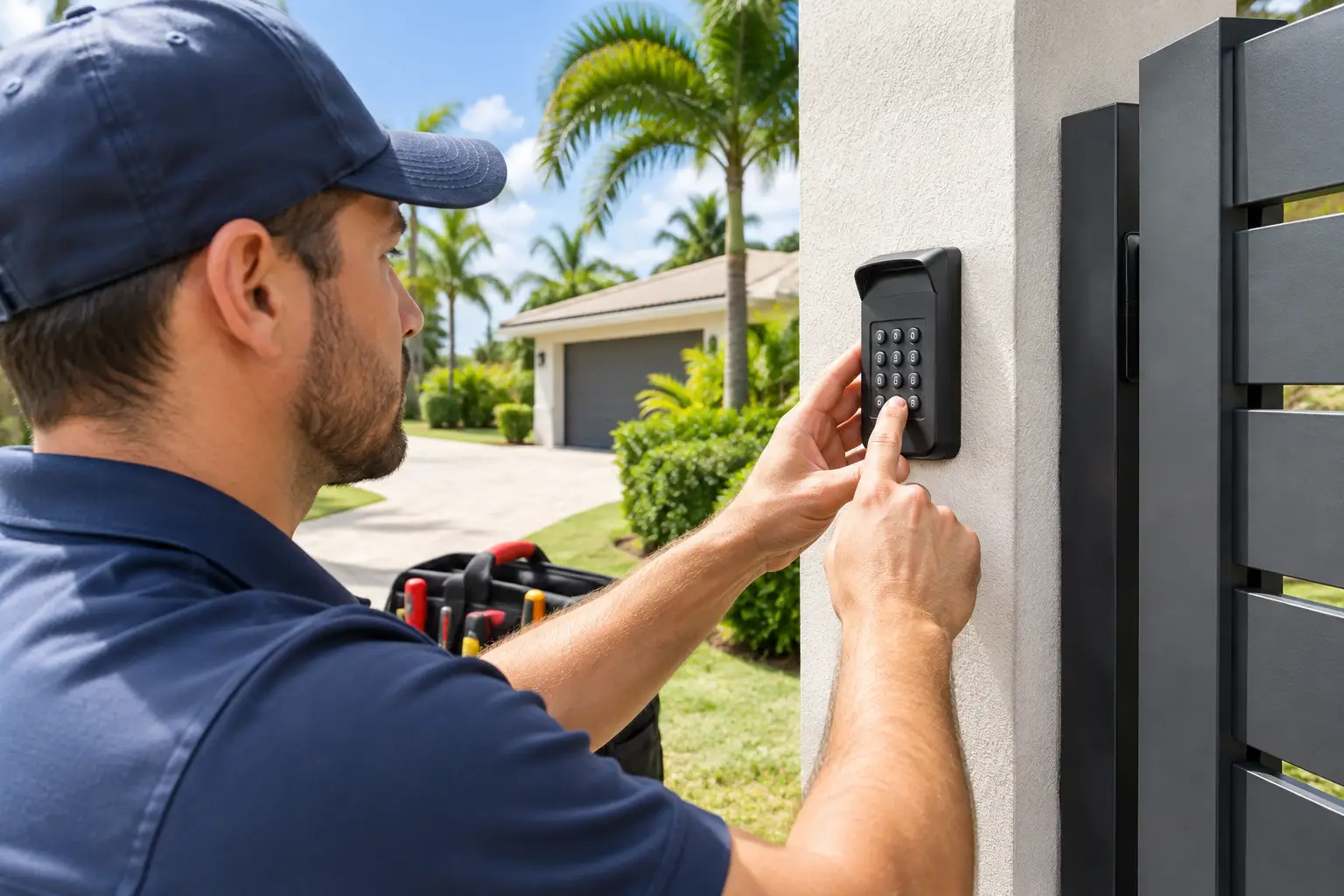
Call (786) 258-8283 for a free estimate on keypad entry system installation. A gate that only opens when someone finds the right remote is not convenient access control. It is a daily weak point - especially for families, rental properties, HOAs, warehouses, and businesses managing multiple users, deliveries, and service crews.
A properly installed keypad gives people a controlled way to enter without passing around remotes, keys, or gate clickers. But the keypad is only one part of the system. Its location, wiring, power source, gate operator, safety devices, credential rules, and exposure to South Florida weather all affect whether it works reliably when you need it.
What a Keypad Entry System Actually Controls
A keypad entry system lets an approved user trigger a gate, garage door, parking barrier, or controlled door by entering a code. For a residential driveway gate, the keypad generally sends a signal to the gate operator, which starts the opening cycle. At commercial properties, it may be part of a larger system that also manages RFID tags, cards, telephone entry, cameras, vehicle loops, and individual access schedules.
The main advantage is accountability and flexibility. A homeowner can give a temporary code to a dog walker or contractor instead of handing over a permanent remote. A property manager can assign different codes to vendors, tenants, or employees and remove access when a job ends. The right setup reduces the need to rekey locks or collect missing clickers.
That does not mean every property needs the most complex access-control package. A single-family home with one driveway gate may need a durable wired keypad and a few managed codes. A warehouse with employee shifts, delivery traffic, and restricted areas may need a more advanced system with audit records, controlled schedules, and integration with cameras or a telephone-entry unit.
Start With the Gate, Not the Keypad
The first question is not which keypad looks best. It is whether the existing gate and operator are safe, compatible, and dependable enough to automate access.
A gate that drags, binds, reverses unexpectedly, or has damaged rollers can overload the operator no matter how good the keypad is. A sliding gate with a worn track or a swing gate with loose hinges should be repaired before new access equipment is added. The same applies to garage doors: a keypad cannot solve a door that is out of balance, has broken springs, or has a failing opener.
A professional site review should check the operator controls, available voltage, low-voltage wiring path, photocells, edge sensors where applicable, emergency release function, and the condition of the gate itself. For commercial gates, vehicle loops and fire-access requirements may also affect the installation plan.
This is where an end-to-end contractor matters. Mechanical gate work, electrical connections, access programming, and safety testing need to work together. Installing a keypad without correcting the underlying gate issue can leave you with a new device attached to an unreliable entry system.
Wired vs. Wireless Keypad Entry System Installation
Both wired and wireless keypads have a place. The best choice depends on distance, site conditions, security expectations, and how often the entry point is used.
Wired systems for permanent, dependable access
A wired keypad connects to the operator or access-control panel through protected low-voltage wiring. It is usually the stronger option for a primary driveway, busy commercial entrance, or any location where battery changes and signal interruptions would create problems.
Wiring takes more planning. Technicians need to choose a protected route, avoid damage from vehicles and landscaping, and keep connections dry and secure. The extra installation work is often worthwhile because the system has a consistent connection and can support more advanced functions.
Wireless systems for practical upgrades
A wireless keypad can be a good solution where trenching is not practical or where a property needs a quicker upgrade. These units may run on batteries or communicate through a radio receiver.
The trade-off is maintenance and range. Battery-powered units need regular attention, and metal gates, masonry columns, long driveways, and electronic interference can affect signal performance. A wireless keypad may be suitable for light residential use, but it should not be selected simply because it is easier to mount.
South Florida Weather Changes the Installation Standard
Heat, humidity, heavy rain, salt air, and storm exposure are hard on exterior equipment in Broward County. A keypad mounted in the wrong location can develop faded buttons, moisture intrusion, corrosion at terminals, or intermittent operation long before its expected service life.
Placement should protect the unit from direct spray and standing water while keeping it easy for a driver or pedestrian to reach. A keypad cannot be so close to the gate that a vehicle is positioned in a pinch point while entering a code. It also needs a solid mounting surface. A loose post, cracked masonry, or unstable fence section will eventually damage wiring and connections.
Outdoor-rated equipment, weather-protected wire connections, secure conduit where needed, and properly sealed penetrations are practical details that make a major difference. At properties in the High-Velocity Hurricane Zone, the full gate and access setup should be evaluated with Florida Building Code requirements, permits, and applicable documentation in mind. The keypad itself is small, but the gate system it controls may carry larger compliance responsibilities.
Code Setup Is a Security Decision
Once the equipment is installed, programming determines who can enter and when. Using one shared code for everyone is simple, but it creates a problem: when the code spreads, every authorized person may have to learn a new one.
Use separate codes whenever the system allows it. Give permanent residents or key staff their own codes, create limited codes for recurring vendors, and delete temporary codes after a project or visit is complete. Avoid easy choices such as a house number, address digits, repeated numbers, or birthdays that are known to neighbors or employees.
For commercial and HOA settings, define who is authorized to add or remove users. Without that rule, old codes can remain active long after a tenant leaves or an employee is no longer approved for access. Advanced systems can add scheduled access, requiring a code to work only during defined hours. That is useful for cleaning crews, deliveries, contractors, and maintenance teams.
Safety Features Cannot Be Treated as Optional
An entry keypad should make access easier, not create a gate hazard. Every automated gate needs operating safety considered before handoff. Depending on the application, that can include properly functioning photo eyes, monitored edges, vehicle detection loops, warning devices, and an accessible emergency release.
The keypad location matters here too. A visitor should not have to stand in the gate's travel path to operate it. For vehicle entrances, the placement should give drivers enough room to stop, enter a code, and proceed safely without blocking traffic or sitting too close to moving equipment.
After installation, test more than the code. Test opening, closing, reversing response, safety sensors, remote controls, exit devices, and manual release operation. A system that opens on command but fails to detect an obstruction is not ready for normal use.
When It Makes Sense to Add More Than a Keypad
A keypad is often the right first layer of access control. It may not be enough for every property. If you routinely need to see who is at the gate, a video intercom can add useful verification. If frequent users need hands-free vehicle access, RFID tags or long-range readers can reduce lines at a busy entrance. If deliveries and visitors arrive unpredictably, telephone entry can route a call to an approved resident or office contact.
These additions should solve a real operating issue, not add complexity for its own sake. More equipment means more programming, more points to maintain, and more decisions about who manages credentials. The best system is the one your household, staff, or property manager can operate confidently every day.
Choose Installation That Covers the Whole Entry Point
Keypad entry system installation is not a mount-and-program job when it is done correctly. It is an access, safety, wiring, and gate-performance project. For a home, that means dependable entry without distributing remotes to everyone who visits. For a business or community, it means controlled access that can keep pace with staff, tenants, vendors, and changing security needs.
Garage Door Kingdom provides licensed and insured gate, garage door, and access-control service from Sunrise across Broward County. A technician can inspect the existing equipment, explain practical options, and provide a free estimate before work begins.
For keypad access that holds up to real use, real weather, and real security concerns, call (786) 258-8283 and schedule your free estimate.