
Call (786) 258-8283 for a free estimate before choosing a new gate or replacing a failing one. The sliding vs swing gates decision is not just about appearance. It affects how vehicles enter, how much driveway space you keep, how the system handles South Florida weather, and what it takes to maintain secure access over time.
A gate that looks right on a showroom display can be wrong for your property. A swing gate may create a clean, traditional entrance but require more room than your driveway can spare. A sliding gate can save space and work well for wide openings, yet it needs a clear travel path beside the opening. The right answer starts with the site, not a one-size-fits-all preference.
Sliding vs Swing Gates: The Practical Difference
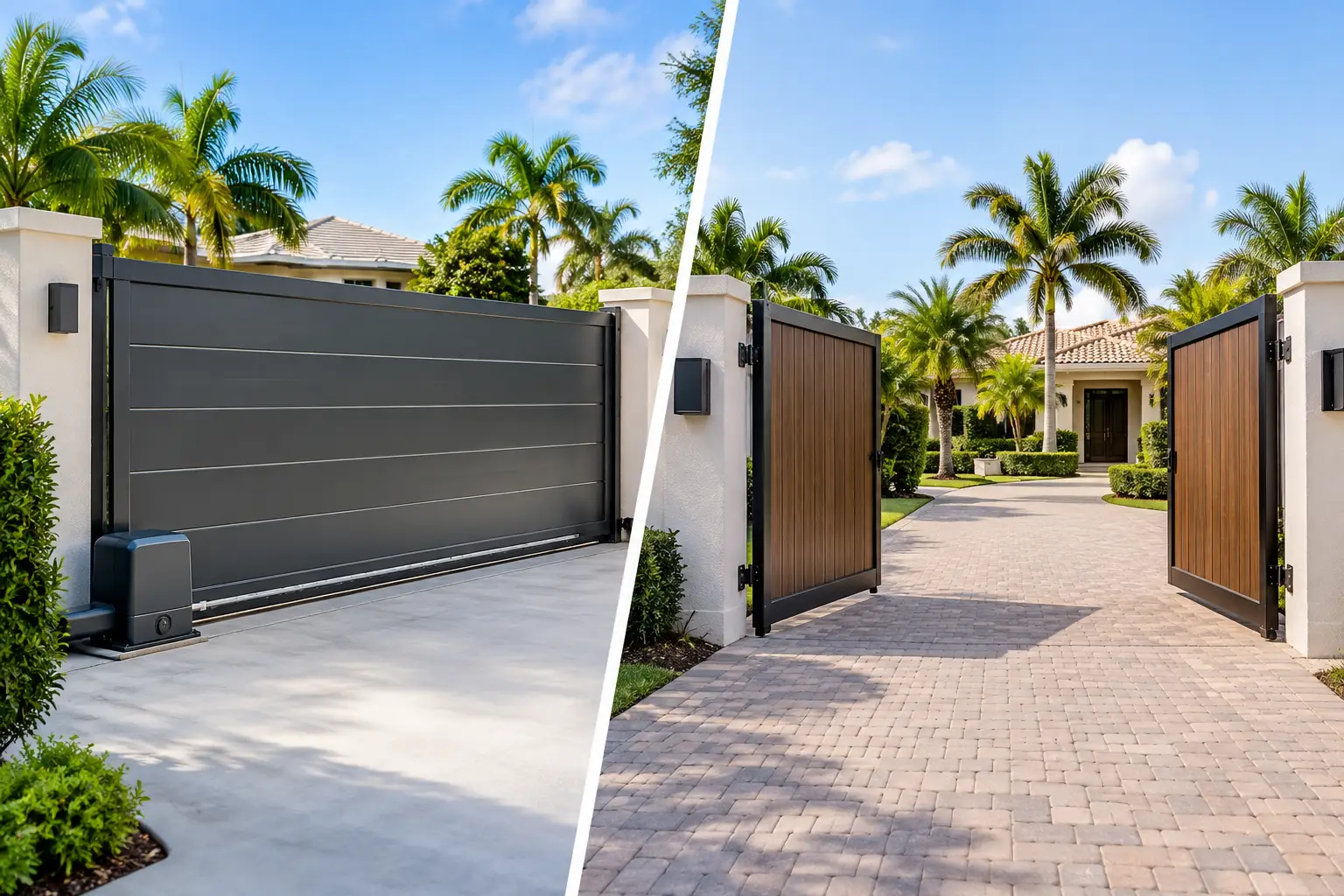
A swing gate opens inward or outward on hinges, much like a large front door. It can be a single leaf or a pair of leaves that meet in the middle. This is often the most familiar option for residential driveways because it has a classic look and can work well on properties with adequate depth behind the gate.
A sliding gate travels sideways, parallel to the fence line. Depending on the design, it may roll on a ground track or operate as a cantilever gate supported above the driveway surface. Sliding systems are common at commercial properties, apartment communities, warehouses, and homes with wide entrances or limited driveway depth.
Neither design is automatically better. The better gate is the one that has room to operate safely, suits the traffic pattern, and can be built and automated for the conditions at your property.
Start With the Space You Actually Have
Driveway geometry is usually the deciding factor. A swing gate needs a clear arc for each leaf. If cars are parked too close to the gate, if the driveway rises sharply, or if the gate would open toward a busy street, a swing setup may become inconvenient or unsafe.
Sliding gates need side room instead. As a general rule, the gate must have enough fence-line space to travel completely clear of the opening. A 16-foot opening, for example, often needs more than 16 feet of usable runback because of the gate frame, counterbalance section, and hardware. Landscaping, utility boxes, mature trees, and uneven terrain can all limit that travel path.
For a tight driveway with no room to swing inward, a sliding gate is often the practical choice. For a property with limited side yard but plenty of driveway depth, a swing gate may make more sense. An on-site measurement matters because a gate that technically fits can still create poor turning clearance for SUVs, delivery vehicles, or work trucks.
Slope Changes the Decision
Sloped driveways deserve special attention. A swing gate can scrape the driveway or lose necessary ground clearance as it opens across a slope. Raising the gate may solve the clearance issue but can create an unwanted gap underneath.
Sliding gates generally avoid the swing-arc problem, but they still need a level, properly prepared path or a cantilever design engineered for the opening. Do not choose based on photos alone when grade changes are involved. The layout, footing requirements, posts, and operator placement should be planned together.
Security and Daily Access
Both styles can provide strong perimeter control when built with the right frame, hinges or rollers, latch hardware, operator, and access controls. The difference is often in how each gate behaves under daily use.
A sliding gate can be a good fit for high-traffic entrances because it moves out of the vehicle path and does not need space inside the driveway to open. For commercial lots, HOA entrances, and properties where multiple vehicles arrive throughout the day, that clear operating pattern is valuable. It also pairs well with keypad entry, telephone entry, RFID credentials, cameras, vehicle loops, and monitored access systems.
Swing gates can be equally secure and are often preferred for private residences where traffic is lighter. A dual-swing gate creates a balanced, upscale entrance and can be automated with underground, articulated-arm, or linear actuators depending on the gate weight and configuration.
The operator should never be selected as an afterthought. A heavy steel gate with an undersized operator will strain components and cause unreliable operation. Safety devices also matter. Photo eyes, reversing controls, edge sensors, emergency release hardware, and properly located controls help prevent a gate from closing on a person, pet, or vehicle.
Hurricane Exposure, Heat, and Salt Air in Broward County
In Broward County, gate selection must account for more than ordinary wear. Heat, humidity, heavy rain, salt exposure near the coast, and hurricane-force conditions can shorten the life of poorly specified components.
Swing gates place wind load directly on their leaves, hinges, posts, and actuators. A solid privacy-style gate catches far more wind than an open picket or ornamental design. That does not rule out swing gates, but it does mean the post foundations, hinges, stops, and automation must be matched to the gate's size, weight, and exposure.
Sliding gates have their own weather considerations. Ground tracks can collect sand, leaves, standing water, and debris, which can affect rolling performance. Cantilever gates avoid a driveway track but require a longer, more substantial gate frame and support system. In either case, corrosion-resistant hardware and regular service are especially important in South Florida.
For new installations, ask how the design addresses local permit requirements, Florida Building Code considerations, and any applicable wind-load or documentation requirements. A gate is part of your property's exterior access system. It should not be treated as a decorative add-on with unknown hardware and no plan for severe weather.
Cost: Look Beyond the Gate Panel
Homeowners often compare the initial price of a sliding gate to a swing gate without accounting for the entire installation. The gate itself is only one part of the system. Posts, footings, electrical work, operators, controls, safety devices, access equipment, fencing transitions, and site preparation all affect the final scope.
A basic swing gate may cost less to install when the driveway is level, the opening is modest, and power is nearby. But costs rise when the project needs heavy posts, dual operators, significant grading, custom fabrication, or specialty access controls.
A sliding gate can require more steel, a larger foundation, a longer fence-line runback, and either a track system or cantilever hardware. It may be the more expensive option upfront, particularly for a long opening. Still, it can be the better long-term value when it solves a space problem that a swing gate cannot.
The most useful estimate identifies what is included: gate material and finish, structural supports, operator capacity, electrical scope, safety equipment, controls, permit-related work if needed, and warranty coverage. A low number that leaves out electrical, controls, or proper foundations is not a comparable quote.
Maintenance Differences That Matter
Every automated gate needs inspection and service. The specific maintenance tasks depend on the design.
Swing gates need attention at the hinges, pivot points, actuator arms, gate stops, latches, and post alignment. Sagging leaves can put extra load on an operator and eventually lead to failure. Keep the swing area clear and watch for changes in gate movement, unusual noise, or a gate that no longer closes evenly.
Sliding gates need clean rollers or tracks, correct chain tension where applicable, aligned guide rollers, and a clear travel path. A track gate should not be forced through accumulated debris. If it hesitates, grinds, or reverses unexpectedly, stop using it until the cause is found. Continuing to run a dragging gate can damage the operator, rack, wheels, or safety system.
For either type, periodic professional maintenance helps catch loose hardware, worn rollers, damaged wiring, corrosion, and safety-device issues before you lose access to the property.
Which Gate Is Right for Your Property?
Choose a swing gate when your driveway has enough clear depth, you want a traditional entrance style, and the site does not create slope or wind-load problems. It is often an excellent residential choice when properly sized and installed.
Choose a sliding gate when driveway depth is limited, the opening is wide, traffic is frequent, or you need the gate to move completely out of the vehicle path. It is often the stronger fit for commercial entrances and properties that need integrated access control.
If your current gate is dragging, stuck open, failing to close, or leaving your property unsecured, call (786) 258-8283. Garage Door Kingdom can inspect the opening, explain the real trade-offs, and provide a free estimate for gate repair, replacement, automation, or a complete access-control upgrade. A properly planned gate should protect your entrance without making daily access harder.