
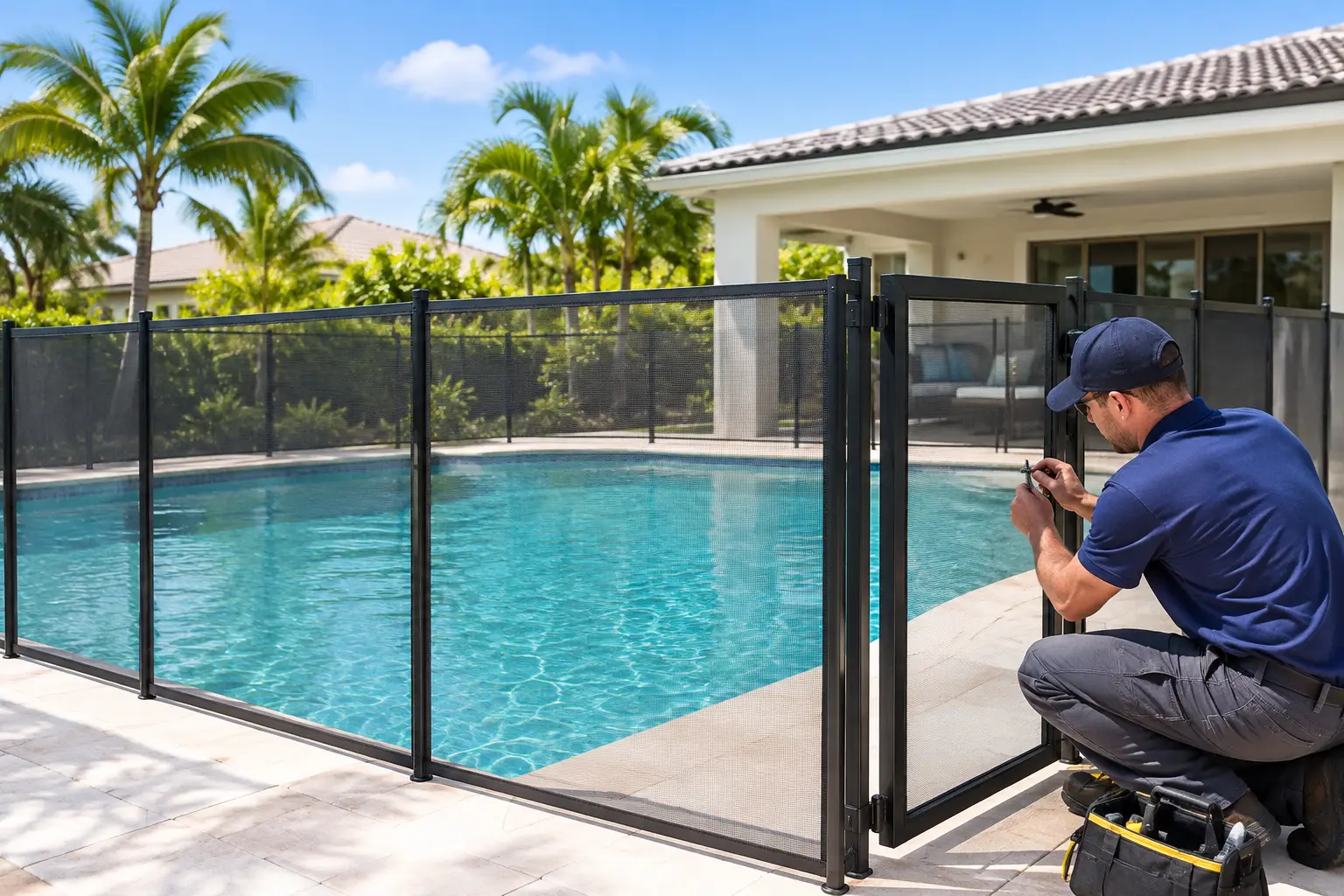
Call (786) 258-8283 for a free estimate before your pool becomes the weak point in your backyard. Pool safety fence installation creates a physical boundary between children, guests, pets, and the water - but only when the fence, gate, anchors, and surrounding area work together as one safety system.
A pool barrier should not be treated as a quick weekend add-on. In Broward County, the heat, heavy rain, shifting deck surfaces, salt air near the coast, and hurricane exposure all affect how a fence performs over time. A professional installation starts with the property layout and ends with a gate that closes and latches reliably every time.
What a Pool Safety Fence Must Accomplish
The job is simple to describe: prevent unsupervised access to the pool. The details are where safety is won or lost. A usable barrier needs to be difficult for a young child to climb, hard to squeeze through or under, and equipped with a gate that returns to a closed, latched position without someone remembering to do it.
The fence also needs to fit the way your family uses the yard. A removable mesh barrier can be an excellent option for homeowners who want a clear visual line to the pool and the flexibility to open the area for supervised gatherings. Aluminum fencing may be a better long-term choice when you want a more permanent perimeter that coordinates with an existing fence, gate, or access-control plan.
Neither material is automatically right for every property. Mesh systems are valued for visibility and removability, while permanent aluminum systems can provide a more defined boundary and curb appeal. The best choice depends on your deck material, pool shape, access points, pets, landscaping, and whether you need the barrier to serve as part of a larger property fence.
Pool Safety Fence Installation Starts With the Layout
Before any post is drilled or any section is ordered, walk the pool area as a child would. Look for access routes from the home, patio doors, side yards, gates, outdoor kitchens, and areas where furniture could be moved against the fence. A barrier can look complete from a distance yet leave a practical bypass through an unprotected side passage.
A site review should identify where the gate belongs, how it will swing, and whether its location keeps traffic away from the water. Gates need room to operate freely without striking furniture, planters, screen enclosures, or uneven pavers. The latch must be placed and adjusted so it cannot be casually defeated, and the closing action should be tested repeatedly rather than assumed to work after the first close.
The deck itself matters just as much. Concrete, pavers, travertine, and other surfaces require different anchoring approaches. Loose pavers, cracked slabs, hollow areas, and poor drainage can undermine post stability. On a removable mesh fence, properly installed sleeves and anchors keep the tension even so the fence does not sag or develop gaps near the bottom.
Landscaping deserves attention too. Dense hedges can hide damaged sections. Trees, patio furniture, grills, storage boxes, and decorative planters can become climbing aids when placed close to a barrier. A safe installation includes enough clearance to inspect the full fence line and keep the area around it free of objects that change how the barrier functions.
Gates Are the Most Important Part of the Barrier
Most pool fence failures are not dramatic. They are small, repeatable problems: a gate that does not fully latch, a hinge that drags after a storm, a self-closing mechanism adjusted too loosely, or a latch obstructed by debris. That is why the gate deserves more inspection than any straight fence section.
A proper pool gate should close and latch from every reasonable opening position. It should not require a hard push, a lift, or a second attempt. The latch and hinges must also withstand South Florida's humidity and frequent rain without corroding or binding.
If your property has an existing pedestrian gate, driveway gate, or screen enclosure, do not assume it can substitute for a dedicated pool barrier. Those systems may control access to the yard, but they may not create the required separation around the pool itself. A professional review can determine whether the existing layout provides adequate protection or needs an additional interior barrier.
Code, Permits, and HOA Rules Need a Real Check
Florida pool-safety requirements and local enforcement can affect barrier height, openings, gate hardware, door alarms, and other layers of protection. Broward County is also in the High-Velocity Hurricane Zone, so exterior work must be planned with local conditions and applicable requirements in mind.
Do not rely on a neighbor's fence design, an old online diagram, or a product description that says it is "code compliant." Compliance depends on the complete installation, not a single fence panel. The applicable Florida Building Code, local permit requirements, pool-safety rules, and HOA standards may all affect the finished project.
That does not mean every pool fence project is complicated. It means the contractor should verify the details before installation, especially when the work involves a new fence line, a gate modification, a shared property boundary, or a major change to the pool deck. Getting this right early prevents expensive rework and avoids finding out at inspection that a gate or clearance is wrong.
South Florida Conditions Change the Maintenance Plan
A pool safety fence is not a set-it-and-forget-it feature. Sun exposure can wear materials over time. Rain and irrigation can leave grit in sleeves or latches. Coastal salt air can accelerate corrosion, particularly on metal hardware. Hurricane preparation can also affect removable sections, gates, and nearby objects that could strike the barrier in high winds.
Check the fence and gate regularly, especially after severe weather or a busy pool gathering. Look for loose posts, sagging mesh, shifted anchors, damaged hardware, gaps under the fence, and gate latches that no longer catch consistently. If the gate begins closing slowly or stops short, address it immediately. A safety barrier that only works when someone gives it extra attention is not doing its job.
For a removable mesh fence, keep the sections properly tensioned and make sure any removed panels are stored securely. Reinstalling a fence section loosely, skipping a post, or leaving the gate unsecured defeats the reason the barrier was installed in the first place.
Questions to Ask Before You Hire an Installer
The lowest quote is not always the lowest long-term cost. Ask whether the installer will inspect the deck condition, identify the full access path around the pool, and test the gate hardware after installation. Ask how the proposed material holds up in heat, moisture, and salt air, and whether the work includes clear guidance on ongoing inspection.
You should also ask who handles permit-related questions and whether the contractor is licensed and insured. If your project connects with existing fencing, gates, or entry controls, it helps to work with one team that understands the whole property-access system rather than treating the pool fence as an isolated piece of hardware.
Garage Door Kingdom provides fence and gate solutions for homeowners across Broward County, with a practical focus on durable installation, secure access, and clear upfront estimates. The goal is not to oversell a fence. It is to build a barrier that fits your property, protects the people using it, and remains dependable in Florida conditions.
A pool fence is most valuable on an ordinary afternoon, when a door is left open, a guest is distracted, or a child moves faster than expected. Call (786) 258-8283 to request a free estimate and get clear answers before installing or upgrading your pool safety barrier.