
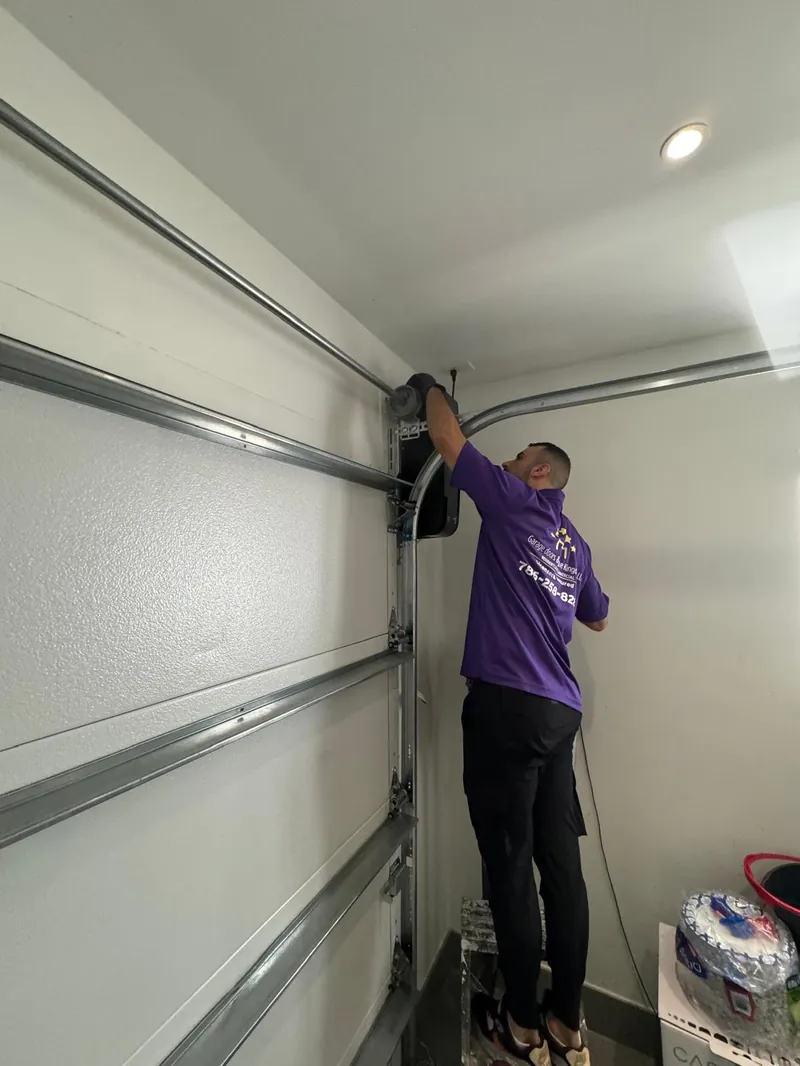
A garage door that opens fine but won't close is almost always a safety sensor problem: the two small photoelectric eyes near the bottom of the tracks are dirty, misaligned, or blocked, so the opener refuses to run a full close cycle. Clean both lenses, make sure nothing is in the doorway, and realign the sensors so both indicator lights glow solid. If the door reverses partway down instead, check the track for debris first, then the force setting. If the door is jerking, sagging, or won't budge at all, that's a spring or cable problem — stop and call a technician. Garage Door Kingdom diagnoses these same-day anywhere in Broward County at (786) 258-8283.
A door that opens without any trouble but won't close is one of the most common calls we get — and it's also one of the easiest to misdiagnose from the driveway. Before you assume the opener itself has failed, walk through the checks below in order. Most "won't close" problems are a sensor issue you can fix in a few minutes; a smaller number point to something mechanical that's worth a technician visit before you keep forcing the door.
Why Won't My Garage Door Close?
In rough order of how often we see them, a door that won't close is caused by:
- Safety sensors blocked, dirty, or misaligned — by far the most common cause.
- Something physically in the doorway or track — a bike, a trash can, a leaf, or standing water reflecting the sensor beam.
- The close-force or travel-limit setting is off — the opener thinks it's hitting an obstruction.
- A remote, keypad, or wall button issue — sending an incomplete or repeated signal.
- A mechanical problem — worn rollers, a bent track, or springs losing tension, which is not a DIY fix.
Safety Sensors Are Blocked, Dirty, or Misaligned
Every garage door opener made since 1993 has two photoelectric safety sensors mounted about 4-6 inches off the floor, one on each side of the track. When their invisible beam is broken, the opener will not run a close cycle — this is a legally required safety feature, not a malfunction to work around.
- Check the lights: Both sensor eyes should show a solid, steady light (color varies by brand). A blinking or dark light means the beam is broken.
- Clear the path: Remove anything sitting in the doorway, including items stored along the track wall that could edge into the beam.
- Clean both lenses: Dust, cobwebs, pollen, and Florida's humidity-driven condensation are the single most common cause of a broken beam. Wipe both lenses with a soft, dry cloth.
- Check alignment: If a sensor bracket was bumped — by a car, a broom, a stored ladder — loosen the wing nut and gently re-aim it until the light on both units turns solid.
- Watch for direct sunlight: Strong morning or afternoon sun hitting the receiver eye directly can wash out the beam. A small shade or shield over the sensor fixes this permanently.
Something Is Blocking the Track, Not Just the Beam
If both sensor lights are solid and the path between them is clear but the door still won't close, check the tracks themselves for debris, a bent section, or standing water pooling near the sensor mount — all of which can interfere with a smooth close cycle even when the electronic beam looks fine.
The Force or Travel-Limit Setting Needs Adjustment
If the door starts closing and reverses partway down every time, in the same spot, the opener's auto-reverse is likely detecting resistance rather than a blocked sensor. This can mean the down-force is set too sensitive for the door's current weight and balance, or the travel limit is telling the opener the door is closed before it's actually reached the floor. Most openers have small force/limit adjustment screws or a menu setting on the motor unit — consult your model's manual before adjusting, since a force setting that's too aggressive defeats the safety reversal feature.
Remote, Keypad, or Wall Button Problems
If the door won't respond to the remote at all but the wall button works fine, the issue is usually a dead remote battery or a rolling-code mismatch rather than the door itself. If the wall button also fails to close the door, the problem is upstream of the remote — back to the sensors or the opener's logic board.
When It's a Spring or Cable Problem, Not a Sensor Problem
Sensor issues stop the door from closing cleanly or trigger an early reversal. A door that's jerking, moving unevenly, sagging to one side, groaning under strain, or won't budge manually with the opener disconnected is a different problem entirely — worn cables, a failing spring, or a bent track. Forcing a door with these symptoms is how cables snap and springs fail suddenly, which can cause injury. That's a same-day repair technician visit, not a sensor adjustment.
When Troubleshooting Won't Fix It — Signs You Need a Technician
Call it in rather than keep cycling the door if you're seeing any of the following:
- Sensor lenses are clean, aligned, and both lights are solid, but the door still won't close.
- The door reverses at the exact same point every time even after clearing the track and adjusting force.
- The door jerks, sags, groans, or feels unusually heavy when moved manually.
- You've had to hold the wall button down to force a close — a sign the sensor circuit itself, not just alignment, may have failed.
At that point it's a wiring, opener board, or mechanical issue rather than a quick fix, and continuing to force the door risks a much bigger repair. We diagnose the difference on-site and, in Broward County's humid, salt-air climate, corroded sensor wiring and connectors are common enough that we check those first on any "won't close" call.
Door Still Won't Close? We'll Diagnose It Same Day.
Garage Door Kingdom repairs safety sensors, openers, and springs throughout Sunrise, Fort Lauderdale, Plantation, Coral Springs, and all of Broward County.
Garage Door Won't Close — FAQs
Why does my garage door open but not close?
This almost always means the opener's safety sensors think something is blocking the doorway. When the sensors are blocked, dirty, or misaligned, the opener refuses to run a full close cycle as a safety precaution — even though nothing is actually in the way. Check the two small photoelectric sensor eyes near the bottom of each track first; that resolves the majority of "opens but won't close" calls.
Why do the sensor lights blink or not light up at all?
A solid, steady light on both sensor eyes means they see each other. A blinking or dark light means the beam is broken — from dirt or condensation on the lens, a sensor bumped out of alignment, sunlight glare hitting the receiver, or a loose wire at the sensor or the motor unit. Wipe both lenses with a soft cloth and gently realign them so both lights turn solid before testing again.
Can I bypass or disable the safety sensors to force the door to close?
No. Federal law has required working safety sensors on garage door openers since 1993, and disabling them removes the system that stops the door from crushing a person, pet, or vehicle underneath it. If holding the wall button down is the only way to close the door, that is a sign the sensors (or the wiring to them) need to be fixed or replaced, not bypassed.
Why does my garage door close partway and reverse back up?
A door that reverses mid-close usually has one of two causes: the auto-reverse safety feature is detecting resistance from a worn or misaligned track, or the opener's close-force setting is set too sensitive for the door's current weight and balance. Debris in the track, a roller starting to fail, or springs that are losing tension can all make the door feel "heavier" partway down and trigger a false reversal.
How do I know if it's the sensors or something else, like a spring?
Sensor problems keep the door from closing at all, or make it reverse very early in the cycle, and the indicator lights will usually show it. A spring or cable problem instead shows up as the door struggling, jerking, moving unevenly side to side, sagging on one side, or an opener that strains and stalls. If the door won't budge under manual operation with the opener disconnected, that points to springs or cables, not sensors — and is not a DIY fix.
Is it safe to keep trying the remote if the door won't close?
Trying the remote a few times while you check the sensors is fine. What is not safe is holding the wall button down to force a close past a triggered safety sensor, or repeatedly forcing a door that is jerking, off-track, or struggling to move — that is when cables snap and springs fail. If the door has any of those symptoms, stop and call a technician instead of continuing to cycle it.